
A Perfect Storm of Good: In the Stream with William Henry
By Jason Rintz
William Henry, LCSW, is a Westchester County-based nature-informed therapist and founder of Riverstone Mental Health Collective. His work centers on helping individuals navigate anxiety, depression, life transitions, and emotional well-being using nature-based and relational approaches. For his own self-care, he spends his free time hiking, camping, and fly fishing.
He serves as the Education Program Coordinator for Reeling in Serenity, a non-profit organization helping individuals in recovery from substance use disorders to heal through fly fishing, conservation, and community. He's also the host of The Nature of Mental Health podcast, where he aims to provide tools for clinicians, nature lovers, and anyone who wants to use nature to improve their well-being.
William recently sat down with NYC TU to discuss fly fishing in the Catskills, volunteering with Trout in the Classroom, and William’s incorporation of nature into his clinical practice.
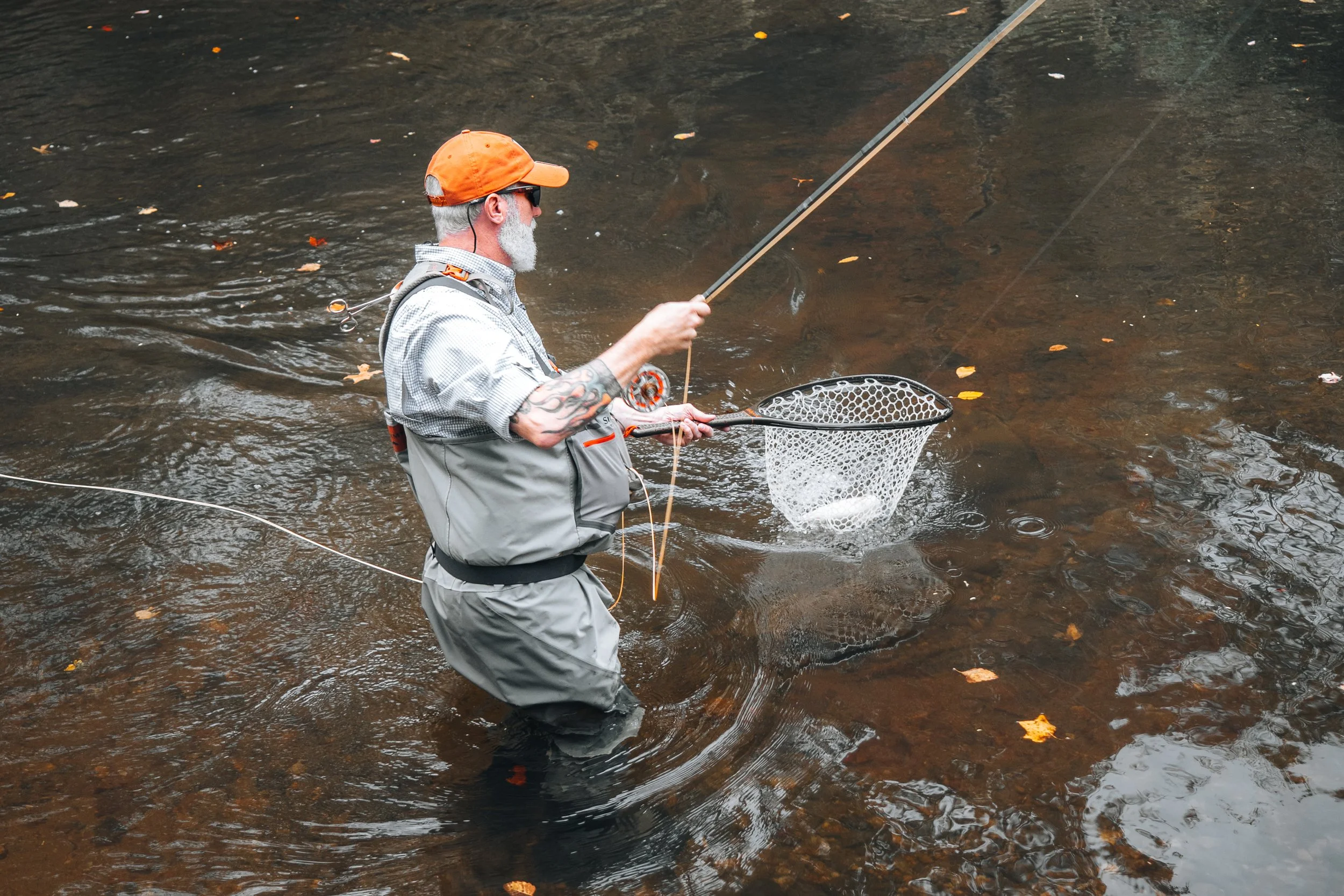
Jason Rintz: Thanks for taking time to talk today. To start at the beginning, when did you first start fishing?
William Henry: I was born and raised in Tennessee. Nature’s always been a big part of my life. My father took me camping once or twice a year in the Great Smoky Mountains National Park. That’s actually where I took my first steps, and where I caught my first fish with a bamboo cane pole, a hook, and a piece of corn.
How did you get into fly fishing in particular?
Other than fishing with my dad or catching sunfish at summer camp, I didn’t fish growing up. When I started camping in the Catskills, I saw people coming home with fish. I bought a six-foot spin rod to learn, but I didn't catch anything because I didn't know what I was doing. While camping on the Beaverkill, a guy walked up with a fly rod and told me he’d caught eight fish. He made it sound involved and evolved; it just felt right. I bought a cheap fly rod—a really cheap one that felt like a stick. You couldn’t really feel anything. After a year I bought my first mid-grade rod, and I thought, this is what it’s supposed to feel like. I bought a five-weight and an eight-weight. Within two or three years, I was salmon fishing. I was all-in.
Was there one moment where it all clicked for you?
I was two years into fly fishing when I had a moment. I was getting my cast right, I could cast a bit farther. I was on Ferdon’s Eddy on the Beaverkill and just had a day. My friend and I each caught 15 trout within a two-hour period on tricos. That’s when it all started to make sense.
NYC TU’s adopted home water, the Amawalk/Muscoot River, is near you in Westchester. Have you fished it much? And what’s your favorite place to fish?
Truth be told, I don’t fish in Westchester as much as I should. The Amawalk/Muscoot is 10 minutes from my house, but honestly I’ve never caught a fish there. Well, I’ve never caught a trout there. I caught a sunny once and thought, this isn’t good, I should probably leave. Probably too warm for trout. My favorite place to go is the Catskills. That’s where I learned to fly fish, and it’s still my favorite spot to go.
What do the Catskills, and the Beaverkill in particular, mean to you?
With the Beaverkill, it’s the lore and history. It’s steeped in all of that. And it’s got so much history for me personally. I got married in the Catskills. My wife and I go camping there. The name of my practice is Riverstone. Half of the name comes from fly fishing and half comes from my metaphorical view of the river. In my office I have a bowl of river stones that I brought from the Beaverkill, because it means so much to me. I feel comfortable and at home when I’m there.
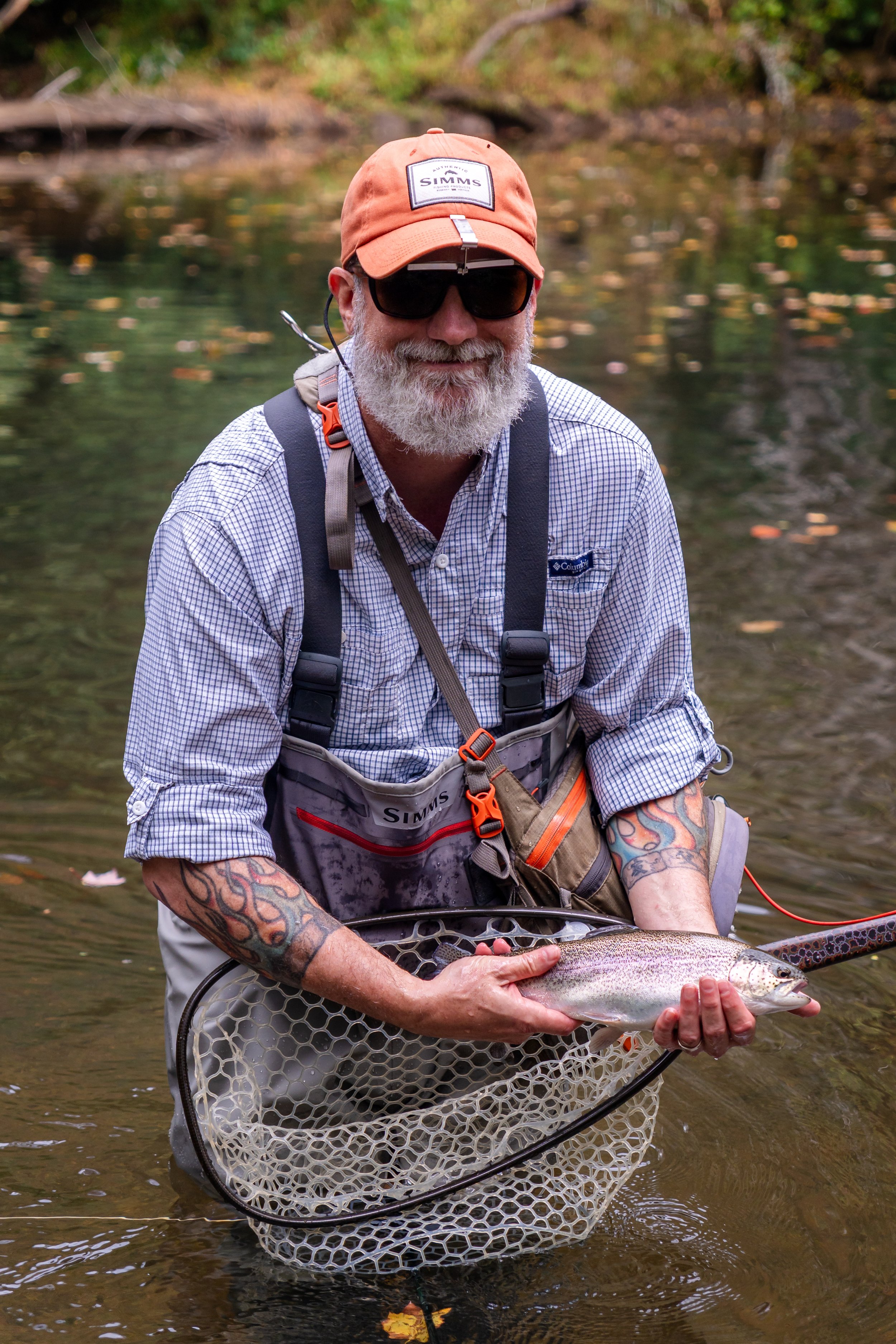
I want to ask about the blending of fly fishing and nature in your therapy practice. You’ve said that “nature can be a wonderful co-therapist.” When did the overlap start for you?
I had a connection with nature when I was a kid, but I became disengaged living in the city. Meeting my wife and getting her into nature helped me re-engage. In 2016 I graduated with my masters in social work, and around then I started fishing more, tying my own flies, spending more time in nature again. I read about nature-informed therapy and it made so much sense to me. There’s so much scientific evidence backing the claim that being in nature is good for our mental, physical, and emotional health. As a species we’ve been on the planet for hundreds of thousands of years, and it’s only in the last couple of hundred years that we’ve gotten more disconnected from nature. The connection is in our DNA. It’s why you feel better when you’re out there.
When did it click for you this was the line of work you wanted to be in?
I’ve been in recovery for almost 19 years. I got sober in 2007, and it was then I asked myself what I wanted to do professionally. I always wanted to help people, especially kids, because I had a hard time myself as a kid. Social work offered me the most opportunities to help young people who are emotionally, mentally, or socially challenged. I remember what it’s like to deal with those challenges.
Congratulations on 19 years. That’s something to be proud of. Speaking of the disconnection from nature: coming out of the pandemic, what are you observing in your clients on that front?
There’s a definite mental health crisis and loneliness epidemic going on. It’s been there for a while, but the pandemic brought it to the fore. I see it across the board with young people and adults. For example, when I took my son to college the president of the school made it clear they were aware of what was going on with the students. He said that 30% of the incoming freshmen have a mental health diagnosis. 15 years ago, it was 20%. That increase is huge. That’s part of why I believe the disconnection from nature is contributing to the mental health crisis. Being in nature is not necessarily the solution, but it’s part of the solution.
How has your work over the last few years changed or reaffirmed your views on loneliness?
I see how important it is to have connections with others. One of the biggest symptoms that people with anxiety or depression experience is loneliness. The cure for that is to reach out, to connect—it’s community. To survive over 200,000 years on the planet, we didn’t do it alone. We did it together, as a community, connected to each other with a common goal.
In my work with clients experiencing anxiety or depression, community is one of the biggest assets that we have. It’s also one of the hardest things to reach out for. Everyone says they feel so much better when they are able to connect with another person. That’s always the response I get. It’s the reaching out that’s the hard part.
It can be difficult to take that first step. What do you tell people to help them reach out?
You just have to say, “Screw it. I’m just going to do it. I’m just going to suffer the consequences of positive action.” Sometimes that’s what it takes. It’s too easy to go back and forth, hem and haw, before you pick up the phone or go to a parent and say, "Hey, I was thinking about you. I’m reaching out.” It’s okay to take baby steps. It doesn’t have to be a big thing. Bite-sized pieces, that’s how we accomplish things.
I’d like to learn a bit more about nature-informed therapy. How do you use it in your practice?
You used the term “co-therapist” earlier; that’s exactly how I use it in my practice. In nature-informed therapy, we go out in nature, and there’s this feeling of innate connection. It’s the natural soft sounds of the wind in the trees, the babble of a brook, the leaves rustling, all of those sounds that are so pleasing, soothing, and calming to us.
I find nature-informed therapy especially beneficial for young people. Trying to get an angsty 17-year-old to sit in front of you and have a face-to-face conversation can be a challenge, but it can be easier if we’re out in nature. I’ll take what I do here in the office and we’ll do walk-and-talks outdoors. There’s less pressure because it’s parallel walking. We’re not staring at each other. There’s less eye contact. For those kids, they don’t feel so trapped in an office.
On top of that, there’s scientific evidence that being in nature lowers the heart rate, lowers cortisol levels, results in calmer breathing patterns. It’s just this perfect storm of good.
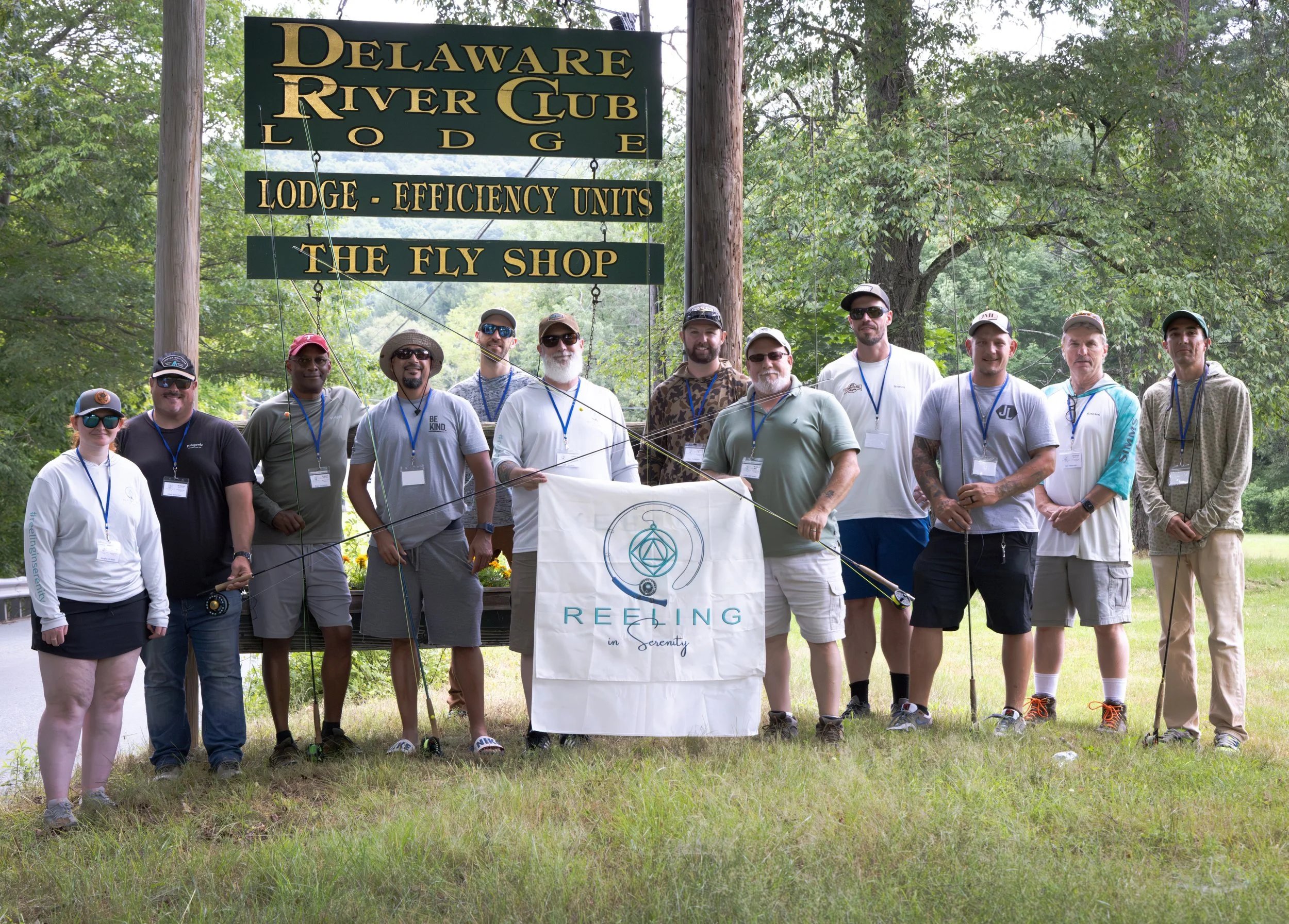
You’re the Education Program Coordinator for Reeling in Serenity. What specific work do you do in that role?
Reeling in Serenity is a small, nation-wide organization. We run retreats that position fly fishing as a therapeutic tool for people in recovery from substance use disorders.
As Education Program Coordinator, my primary job is to develop a standardized curriculum for Reeling in Serenity’s one-day and weekend-long retreats. I also provide therapeutic education at retreats and through the host manual we’re developing. We want to empower others to host a retreat, no matter where they are across the country. There’s a handful of us on staff plus the board members, and it’s 100% volunteer.
I host a retreat on the Beaverkill. We did our first overnight retreat there last year. The river was running at about 36 cfs. The fishing was awful, but sitting around a campfire sharing stories about recovery, that was really powerful.
The retreats are my favorite part of the work. It’s working with people one-on-one. There’s nothing like watching someone’s eyes light up when they’re out there connecting with nature. I feel blessed to be part of the organization.
What is it like for you to teach someone else to fly fish?
It's really amazing, especially when someone realizes the value of being present. It takes an immense amount of presence to drift a fly. Every cast is an opportunity for hope. It’s like the John Buchan quote: “The charm of fishing is that it is the pursuit of what is elusive but attainable, a perpetual series of occasions for hope.” People fish on our retreats and say, “I felt so calm and at peace. I wish I could do this all the time.” And I say, “Well, you can.”
What’s the one thing you want to make sure people know about Reeling in Serenity?
That everyone knows someone who’s been affected by addiction. And that being together to heal doesn’t always mean sitting in a group circle at an Alcoholics Anonymous meeting. Being together and connected can mean taking your fly rod and spending an hour on the river and being at peace. The peace that fly fishing brings me is immeasurable, and I love watching other people experience it, too.
That’s really beautifully said. I’m also curious how you got involved with Trout Unlimited?
I’ve been a member of the Croton Watershed chapter for about 10 years. After I started fishing I saw the Trout Unlimited name everywhere, and I was aware of the conservation efforts. I was looking for a community, and I started attending the monthly meetings and met some really good people.
How did you connect with the NYC chapter?
I met Devin, who’s President of the NYC chapter, while volunteering for Trout in the Classroom last year. It was an amazing experience. The kids are so great. We had 35 or 40 kids show up on the first day I volunteered, and they were so happy. They name their fish, they get really interested in the bugs.
With one group of fifth and sixth graders, we caught a bunch of crayfish. There was one girl in the group who was particularly interested. All the boys were like “ew” and there she is, telling me everything there is to know about crayfish. The kids are so naturally interested and curious. I’m big on curiosity. If everyone was a little more curious, we’d have a more pleasant world.
It was great to foster a new generation into conservation, too. Healthy trout mean healthy water, which means healthy drinking water. That’s an important message to share with these kids. If they’re out on the river and see someone polluting it, they’ll know how to speak up. Or perhaps they’ll pick up one piece of trash.
Thinking about the next generation, what’s the most important thing we can do now as fly fishers to protect trout and cold water streams for younger people?
It’s important to keep things fresh and interesting for them. I love seeing the diversity that's coming into fly fishing now, and the people are getting younger. It’s such an inclusive and welcoming community, as long as you’re conservationally-minded and giving back what other people are giving to you.
That’s the biggest thing: Engaging kids and bringing them in, making them feel like a part of the community. We all belong. We all have a right to access nature. The more curious we are about fishing, conservation of water, nature in general—younger people feel that and will want to be part of it.
It’s time for the “last cast” question. What’s one project or cause you want to draw attention to?
It’s Reeling in Serenity. We’re a 501(c)(3) non-profit who bring community, nature, and fly fishing to people suffering from substance use disorders. Participants must be in active recovery for 30 days or more. The overnight retreats are completely free; all gear and food are provided. All you have to do is show up and experience fly fishing. Everyone is welcome, and you don’t have to be in recovery to volunteer.
It sounds like a great organization.
I’m very proud. It’s my community, it’s my tribe.
I’m glad you found that. Thank you for taking time to chat today.
Of course. It’s my pleasure.